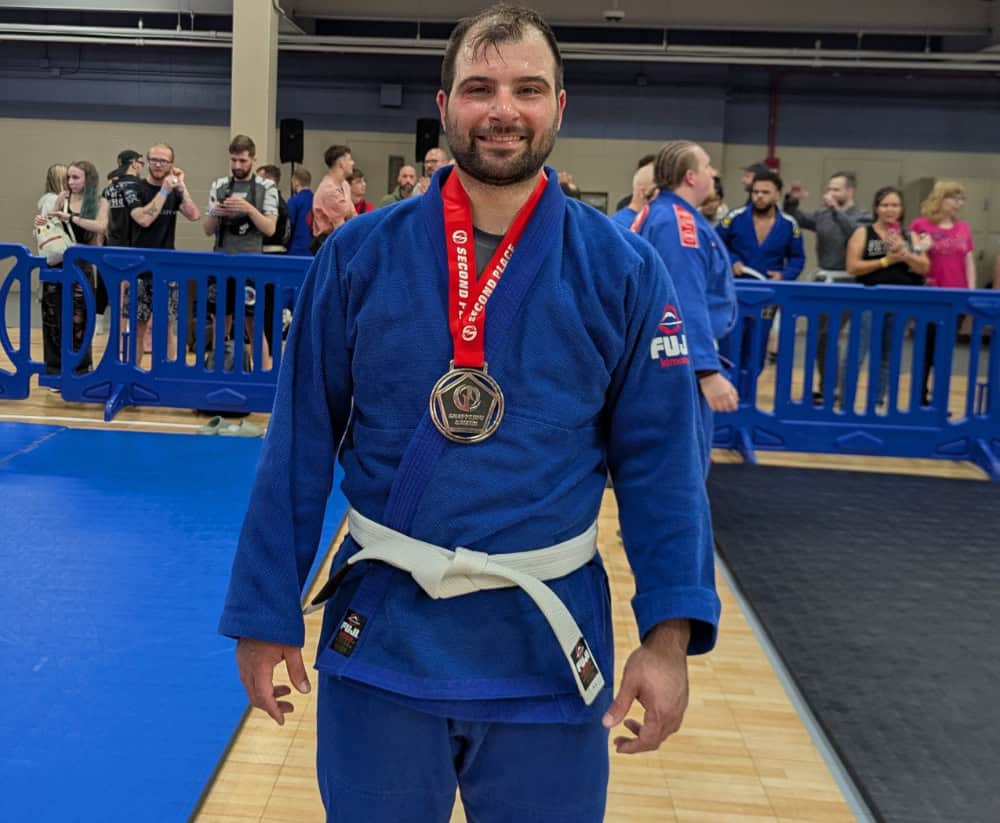
Competition is something that's always been a part of my life...
I started playing Little League baseball as a kid, and even though I was terrible at it, I liked being on a team and trying to improve. I moved on to football (American), and while I wasn’t terrible at it, it also wasn’t something that fully clicked. It wasn’t until I started wrestling in high school that a sport just felt right. I stopped competing in wrestling over 20 years ago, but I’ve been looking for something to push myself that’s similar but not as intense. Enter BJJ.
When I first started looking into BJJ gyms, one of the things I wanted to do was begin competing again. As I started seriously considering getting into BJJ and choosing a gym; there were two things I was looking at:
- The vibes.
- A place to grow as a competitor.
I was trying a few places when I reached out to Coach Ramses at Living Art BJJ. As soon as we started, I knew this was where I wanted to train.
Having been training for just under a year, I decided this was a perfect time to try my hand at competing. I looked up dates for upcoming events and chose to compete at a Grappling Games tournament. I signed up for the gi and no-gi divisions.
Preparation
Now, if you don’t want to, you don’t have to do anything different in your training. You can just go to class as usual, maybe get some extra rolls in, and show up to the competition. For your first competition, this may be the way to go because adding additional stress/complexities can throw people off. When I coach people in powerlifting for their first meet, I tell them not to worry about hitting PR’s or adjusting their training. Competing is its own skillset.
If you decide to up your training, my suggestion is to start with increasing your fitness. What I was not ready for was the intensity that my opponents had. To say I was gassed after my first match in an understatement. I would have enjoyed myself more if I were in better shape. You can up your intensity during open rolls, get more rolls in, or do more conditioning (running, bike, etc.).

One thing I consider as a non-negotiable is going into your competition with a game plan. This starts with understanding what you are good at and working with your coach on refining your go-to moves. What’s your favorite takedown? Do you like to pull guard? What’s the guard you’re most comfortable in? Your smoothest sweep? What submission just calls your name? As you get closer to competition, you should start narrowing down what you do during open rolls and concentrate on what you’ll be using. Maybe even work on a weakness like breaking grips (cough). When you show up on competition day, you shouldn’t be thinking about what you’re going to do during your match because you’ve been practicing it.
What You Can and Cannot Do - Understanding the Rules
Every organization has a set of rules separated by age and experience level. White belt is the most restrictive, but that also means there’s less to worry about (none of the advanced submissions that the upper belts keep hitting on you). Lower body attacks, if permitted, are limited to straight ankle locks. All you have to worry about are chokes, arm bars, shoulder locks, and pressure submissions.
One thing to really study is the points scoring system. You should ask your coach what moves or positions score, how much they score, and how to properly defend them. Case in point, I was taken down, turned to turtle, and allowed the person to get both hooks in, giving up four points. If I would have defended the hooks, all I would have allowed my opponent to score was the two points for the takedown.
Night Before
Nutrition and hydration begin the night before the meet. Make sure you eat and drink an appropriate amount, but just keep in mind that you’ll have to weigh in the next morning. This is also not a good time to be adventurous with your food. Have a simple meal with some protein, carbs, vegetables (if you want), and eat at a normal time to give yourself time to digest. For me that meant getting some Chipotle (of course with guac). Picking up the food allowed me to:
- Not worry about cooking, and,
- Eat something I know I’ll like and is clean for performance.
The day before is also a good time to get all your gear and food/drinks ready. Again, it’s important to know your body. I know that I don’t do well with a lot of food in my body, so I made a PB&J that I could nibble on if I got hungry, as well as some Nature Valley bars. For hydration, I packed some waters, a Gatorade, and a couple electrolyte drinks. I tend to over-prepare, so having extra stuff gave me peace of mind.
Since my plan was to do both gi and no-gi, I made sure I had everything clean and ready the night before. Because I have two gi’s, I brought both just in case (see over-prepared above), which wasn’t necessary, but YOLO. I also packed my no-gi stuff, along with changes of underwear. It feels so refreshing to change your underwear after you’re done or switching types of competition.
On top of this, remember to bring all your normal jiu jitsu accoutrement, i.e. mouthpiece, tape, etc… My list consisted of mouth guard, bandaids, athletic tape, and bands for warming up my joints. Make sure your nails are cut and clean. You don’t want to be the person looking for a nail clipper and clipping over a garbage can at the tournament.
Now that everything was packed and double checked, I could relax and get some sleep. I know being my first competition in forever I wouldn’t get the best sleep, but I went to bed early and got what sleep I could. Do your normal sleep routine, be that dead silence, listening to music, or watching Bob Ross make happy little accidents.
Day of Competition
Now that you’re rested and ready, it’s time to get your normal training routine going. Please do not change anything for competition in how you get ready before leaving the house for practice. Follow the same routine as much as possible, making adjustments for the different times. For me, that means eating two-three hours before rolling. For my competition, I ate three hours before, giving myself enough time to digest. I do not do well with food in my stomach, so I prefer to be a bit hungry when rolling. I ate a bowl of oatmeal with some peanut butter and raisins, which was perfect for comp day. I also made sure to drink at least a bottle of water to stay hydrated.
When it was time to leave, I checked again that I had everything. Having forgotten my belt a couple times for practice, I did not want that to be the case in a place where I couldn’t just grab an extra one or borrow from a teammate. Once everything was checked, it was off to the comp venue. I got there about an hour early, which gave me plenty of time to find parking, get weighed in, and settle in. The organization you’re competing under should have live brackets and updated times on when your first match will be. Just keep checking the night before and morning of to make sure nothing drastic changes. For me, the time moved to about an hour earlier, so it was good that I was checking.
If you haven’t weighed in before, it’s not an involved process. When I checked in, they had a scale I just stepped on and that was it. I was already in my gi pants and didn’t have to take them off. With some organizations, you won’t be able to weigh in with pants on, so just be ready with shorts. Since we’re speaking of weight, you’ve probably noticed I haven’t spoken much about checking weight with eating and drinking. That’s because for your first comp, you should not try to cut any weight. There are too many things for you to keep track of on top of changing your diet, besides the fact that not everyone responds well to cutting. So, do yourself a favor and compete in a weight class where you don’t have to worry about losing any weight. The only consideration for this is if you’re on the cusp of the heaviest weight class and the one below, only because that one could range from a few pounds heavier to 50 plus. That’s a conversation between you and your coach who will be better at guiding you.
As we’ve discussed before, you should know what it takes for you to warm up. There may be practice mats on the side, so take advantage of them. I like to begin warming up about 30-40 minutes before my first serious roll. I’ve already taped everything that needs it. I start with my band routine, do some stretching, then do some pushups and squats to get blood flow going. I didn’t have a partner, so I did some light solo drilling. After that, I just kind of hopped around until it was my time to go.
I really like having a sweat going before I start. Remember, you aren’t doing any instructional or drilling. Your first time stepping onto the mat will be a full-energy endeavor. Having my heart rate already going makes me feel like I’m continuing instead of just ramping up all at once.
First Match
I cannot emphasize enough how hard and tiring your first match will be. Unless you come from a competition specific gym, most of your rolls won’t be at such a high intensity. Unfortunately, that’s exactly what this will be. But that’s okay, because that’s part of the fun!
My first match was against someone taller and longer than me, which I’ve always struggled with as far back as my highschool wrestling days. He was good at reaching over my arms and getting his collar grips, which I am abysmal at defending. I have a good base, so I wasn’t getting man handled right away, but I was at a distinct disadvantage. We basically just hand fought for the first three minutes until he was able to whip me down, giving him the takedown and two points. I managed to get into half guard, which is an accomplishment for me. I ended up getting into turtle position, where instead of listening to my coach and defending the hooks coming on, I reverted into my wrestling and tried to pull him off, which let him get his hooks in, giving up an additional four points. I did manage to get him off of me with about 45 seconds left. I had to defend two submission attempts before I could try passing his guard, cutting my available time to about 20 seconds. I tried throwing his legs by, but he had my sleeves locked down and I just couldn’t pass in the time remaining. The match ended with me losing 0-6.

Second Match
Before we go into my second match, let’s talk about adrenaline dump. This “phenomenon” happens whenever a person’s adrenaline goes from regular to 100% in a short period of time, in particular for a sustained period of time. You know the feeling when something out of nowhere scares you and your heart races like crazy? It’s that feeling, but for your whole match. I thought I was better prepared for it, but I still crashed after my first match. I could not catch my breath, I felt nauseous, and my grip felt like linguini. I did mostly recover in time for my second match, but just be prepared to ride it out for a few minutes after your first match.
My second match was with someone much more similar in height and with wrestling experience. That made me feel more comfortable because I knew what to expect. We went back and forth trying to take each other down. I finally put him on his back with a short carry and passed his guard. I didn’t keep any pressure, so he turtled, but I held it enough to get three points for passing his guard. We had to reset because we went out of bounds. My coach had prepared me, and reminded me, to get my same grips when we reset. Sometimes people try to get an advantage and change some things from the old position. Thankfully my opponent wasn’t trying to fight me on getting my old position. When we reset, I was able to get my hooks in and score four more points.